
If your small business needs more customers, start by finding where people drop out. Are too few suitable people discovering you? Do they visit but not enquire? Or do enquiries arrive and then stall? Each problem calls for a different next step.
More posts, ads or website changes will not help much if they address the wrong part of the journey. Use the checks below to identify the bottleneck, make one useful improvement, and see whether it changes the enquiries your business receives.
Where are you losing potential customers?
Think of the journey in four stages: people discover your business, decide whether it fits, contact you, then choose whether to buy or book. Check actual enquiries and customer conversations as well as website data; a click is not the same thing as a received enquiry.
| What you notice | What to check | A useful first action |
|---|---|---|
| Few relevant people find you | Search visibility, referrals, and whether your service and location are clear | Improve the main service page and, if eligible, check your Google Business Profile |
| People visit but rarely enquire | Missing answers, weak examples, confusing navigation, or a hidden next step | Answer the main buying questions and make one clear contact action easy to find |
| People try to contact you but messages go missing | Form delivery, confirmation, phone links, and who owns the inbox | Send a test enquiry from a phone and follow it through to the person responsible |
| Enquiries are a poor fit | Service scope, service area, availability, and price expectations | Explain who the service suits and what affects the quote |
| Suitable enquiries rarely become customers | Response time, unanswered questions, proposal clarity, and follow-up | Review recent conversations and note where decisions stalled |
Before drawing conclusions, check that measurement and contact delivery work. A site can appear to generate no leads because tracking is incomplete, a form fails silently, or a message reaches an unattended inbox.
How do I get my business found on Google in Cyprus?
Make it easy for people and search systems to understand what you do, where you serve customers, and how to contact you. Start with accurate information on your own site: name your real services, explain the locations you cover, and keep your contact details current.
A Google Business Profile can support local visibility if your business is eligible. Google says a business must make in-person contact with customers during its stated hours; online-only businesses do not qualify. Check Google’s Business Profile eligibility rules before creating a profile.
For an eligible business, keep the profile’s real category, hours, contact details and service area accurate. Google says local results depend mainly on relevance, distance and prominence. Those factors mean no profile can guarantee a fixed position across Cyprus, and there is no way to pay Google for a better organic local ranking. See Google’s guidance on local ranking.
Your service pages should be equally specific. “Garden maintenance in Paphos, including regular care and one-off clearance” tells a potential customer more than “quality solutions for every need”—provided that description is true of your business. Build a location page only when you have useful local information to offer, such as availability, completed work, or arrangements that differ by area.
For the Google setup itself, see our step-by-step guide to getting your business found on Google.
Why is my website getting visitors but not generating leads?
A visitor needs to see that your service fits, find enough evidence to trust the choice, and understand what to do next. Look at the pages people actually use and ask whether they can quickly answer:
- What do you provide, and is it right for my situation?
- Do you serve my town or area?
- What examples or details help me judge the work?
- What affects the price, timing, or availability?
- How do I enquire, and what happens after I do?
Make the next step concrete: “Request a renovation quote,” “Check appointment availability,” or “Ask about delivery to your area.” Then test the whole route on a phone. Submit the form, check the confirmation, and verify that the message reaches the right person. Test the phone and messaging links too.
A contact-button click tells you someone showed interest. A message received by your business tells you contact happened. Keep those measures separate so the numbers answer the right question.
What does a useful business website answer look like?
For Dr George Konstantinidis, a consultant orthopaedic surgeon in Cyprus, DM Labs built a site with separate specialty pages, patient information, clinic locations and contact options. The site provides English, Greek and Russian versions.
The practical lesson is about information structure: a visitor can move from a question about a specialty to the relevant location and contact details. This example shows the site’s organisation and features; it does not claim an increase in enquiries or appointments.
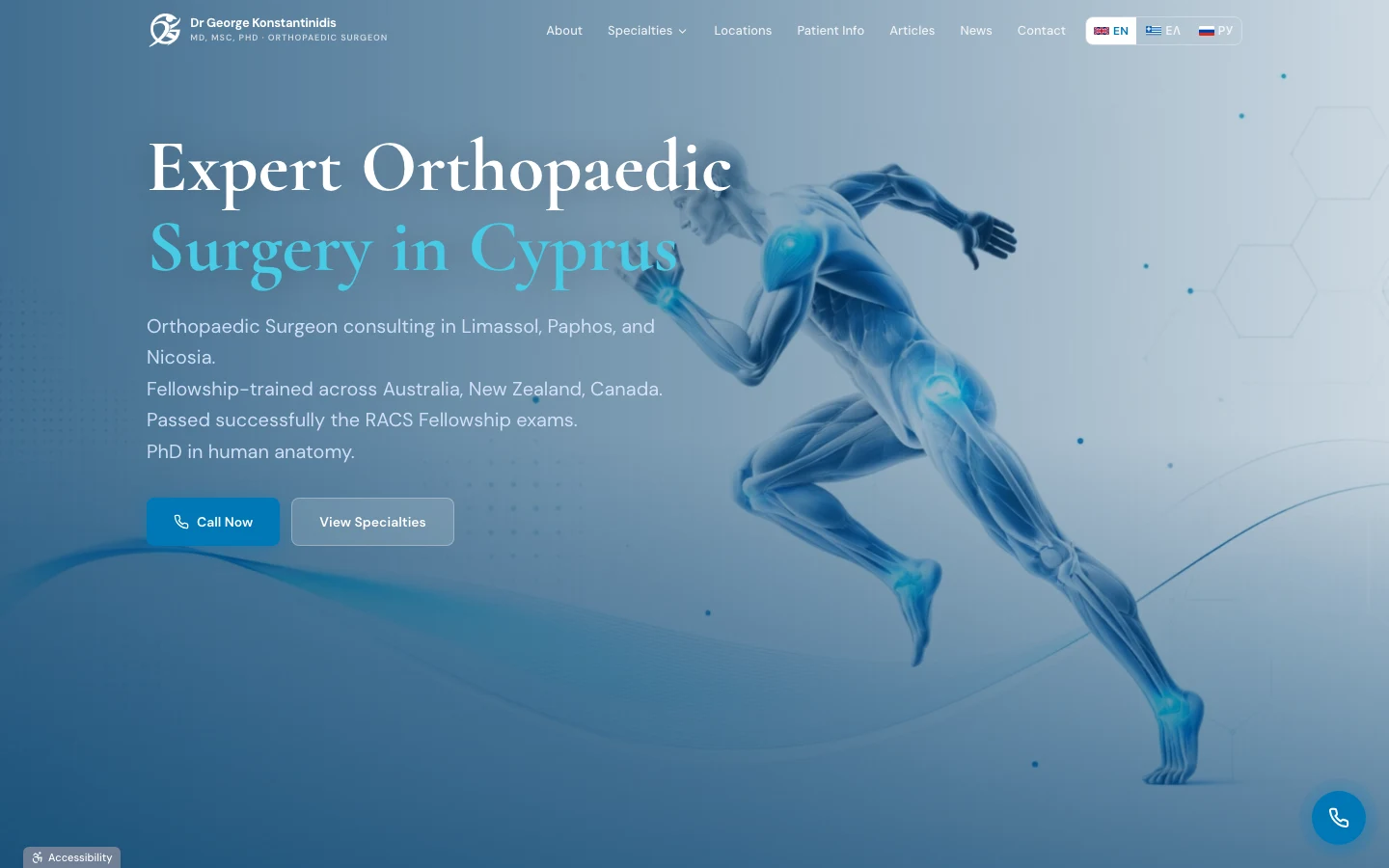
See the full Dr George website case study for more screenshots and project details.
How can one homepage guide two different audiences?
Perfectus Beauty’s Arosha distributor website in Cyprus and Greece serves beauty professionals as well as people looking for products for home use. Its homepage makes two routes clear near the top: explore products or go to professional training. Further down, it separates professional treatments from home-use products and explains where training fits.
That structure helps visitors start with the reason they came, rather than guess which part of a broad catalogue is meant for them. The useful principle is simple: when a business serves different audiences, name those audiences and give each a clear next step, then keep the route consistent through to contact.

Explore the Perfectus Beauty website and its professional training page. This example shows how the information is organised; it does not claim a measured increase in enquiries or sales.
Do I need a website if I already have Facebook or Instagram?
Social media can help people discover your business and keep up with it. A website gives you a place to organise the information customers need before they decide, and a contact or booking route you can shape around your business.
Start with the questions customers repeatedly send you. A restaurant might need a current menu, hours and reservation details; a beauty studio may need treatment descriptions, prices and appointment options; a tradesperson may need examples of work and a clear service area. Put the answers somewhere easy to find, then use social posts to point to the relevant page.
You may only need a small, focused site. For restaurant-specific choices, see our guide to what a restaurant website should help diners do.
Should my business website be in Greek and English?
Choose languages based on the customers you serve and the languages in which you can support them. If your customers use both Greek and English, both versions may help. Use actual enquiries, booking details and customer conversations to decide whether another language is worth maintaining.
Translate the full route to action: service details, prices or quotation guidance, locations, form labels, confirmation messages and booking instructions. A translated homepage is of little use if the customer reaches an untranslated form. Keep essential details consistent and update every language when services or availability change.
How can I get more customers without increasing my advertising budget?
Start with the evidence and relationships you already have. Ask customers for honest feedback and make it easy for them to recommend you. Talk with complementary businesses that serve similar customers. Keep public business details current.
Notice the questions that come up before someone buys. If several customers ask the same thing, answer it on the service page where that decision happens. Then review recent enquiries: did you respond while the person was still deciding, answer their question, and make the next step clear?
For example, a villa owner considering direct bookings can check whether guests can understand availability, total prices, property details and booking arrangements. Our guide for property and hospitality websites looks more closely at those decisions.
Should I improve my website before spending on advertising?
Test the page and the contact process before paying to send more people there. Ask someone who does not know the business to open the intended page on a phone. Can they explain the offer and complete the action you want a customer to take? Do you receive their enquiry?
If the page works and too few suitable people reach it, attracting more visitors may be the next step. If people arrive but encounter unanswered questions, a broken form or an unclear offer, fix that friction first. You do not need a perfect website; you do need a clear offer and a working route to contact.
How do I know which changes are bringing customers?
Track the path from website visits to enquiries to customers. A simple enquiry log can record the date, source when known, requested service, whether the enquiry was suitable, and its eventual outcome.
Two useful calculations are:
- Website enquiry rate = received website enquiries ÷ website sessions × 100
- Enquiry-to-customer rate = customers from those enquiries ÷ enquiries × 100
Suppose a business has 200 website sessions, receives eight completed enquiries, and two of those enquiries become customers. That is a 4% enquiry rate and a 25% enquiry-to-customer rate. This is a hypothetical calculation, not an industry benchmark.
Use the same definitions over time. Do not count contact-button clicks as received enquiries. If customers take weeks to decide, allow enquiries from a period enough time to reach an outcome before comparing sales rates. More visits with fewer suitable enquiries may indicate an audience mismatch; suitable enquiries that rarely become sales may point to price, availability, fit or follow-up.
What should I work on this week?
- Review recent enquiries. Note what people asked, how they found you and where decisions stopped.
- Check your business details. Make sure your website and any eligible Google profile show the right contact, service area and hours.
- Improve your main service page. Explain the offer, who it suits, what affects the quote, and the next step.
- Add real evidence. Use a project example, photographs or an explanation of how the work is done.
- Test contact on mobile. Confirm the form, phone link and inbox all work end to end.
- Answer one recurring question. Add the answer to the page where customers need it.
- Choose what to measure next. Compare suitable enquiries and outcomes after enough time has passed.
This is a way to find and address gaps, not a promise that every business will see results in seven days.
Do I need a new website to get more customers?
Not always. If the current site works on mobile and is straightforward to update, clearer service information, a stronger project example or a simpler enquiry process may be enough. A rebuild is more relevant when the site is hard to maintain, consistently awkward to use, or cannot support what customers need to do.
Before hiring a provider, ask what problem the work will solve, what is included, who will maintain the content and how you will assess the result. Read our website cost guide and compare the current DM Labs website services.
Want help identifying the next useful improvement?
DM Labs builds custom websites around your services, your customers’ questions and the actions you want visitors to take. If you contact us, include your website address, the locations you serve, and the kind of enquiries you want. Tell us what is happening now—few visitors, few enquiries, or enquiries that do not fit—and we can discuss a suitable scope.
Talk through the customer journey on your website
Share what customers are asking and where you think they are getting stuck. We’ll help you identify a practical next step.
Talk to DM LabsRelated reading: Getting your business found on Google · Improving website leads for property and hospitality · Website costs in Cyprus
FAQ
How quickly can a website change bring more customers?
There is no dependable timetable or guaranteed result. First make sure the change fixes a real obstacle, then compare suitable enquiries and sales over a period that gives customers time to decide.
Do I need a Google Business Profile?
Only if the business is eligible. Google requires businesses to make in-person contact with customers during stated hours. Online-only businesses are not eligible; check Google’s current eligibility rules before creating a profile.
Should I advertise before improving my website?
Test the page and enquiry route first. If they work and too few suitable people arrive, advertising may help reach them. If the page is confusing or the form fails, fix that friction before paying to send more visitors.