
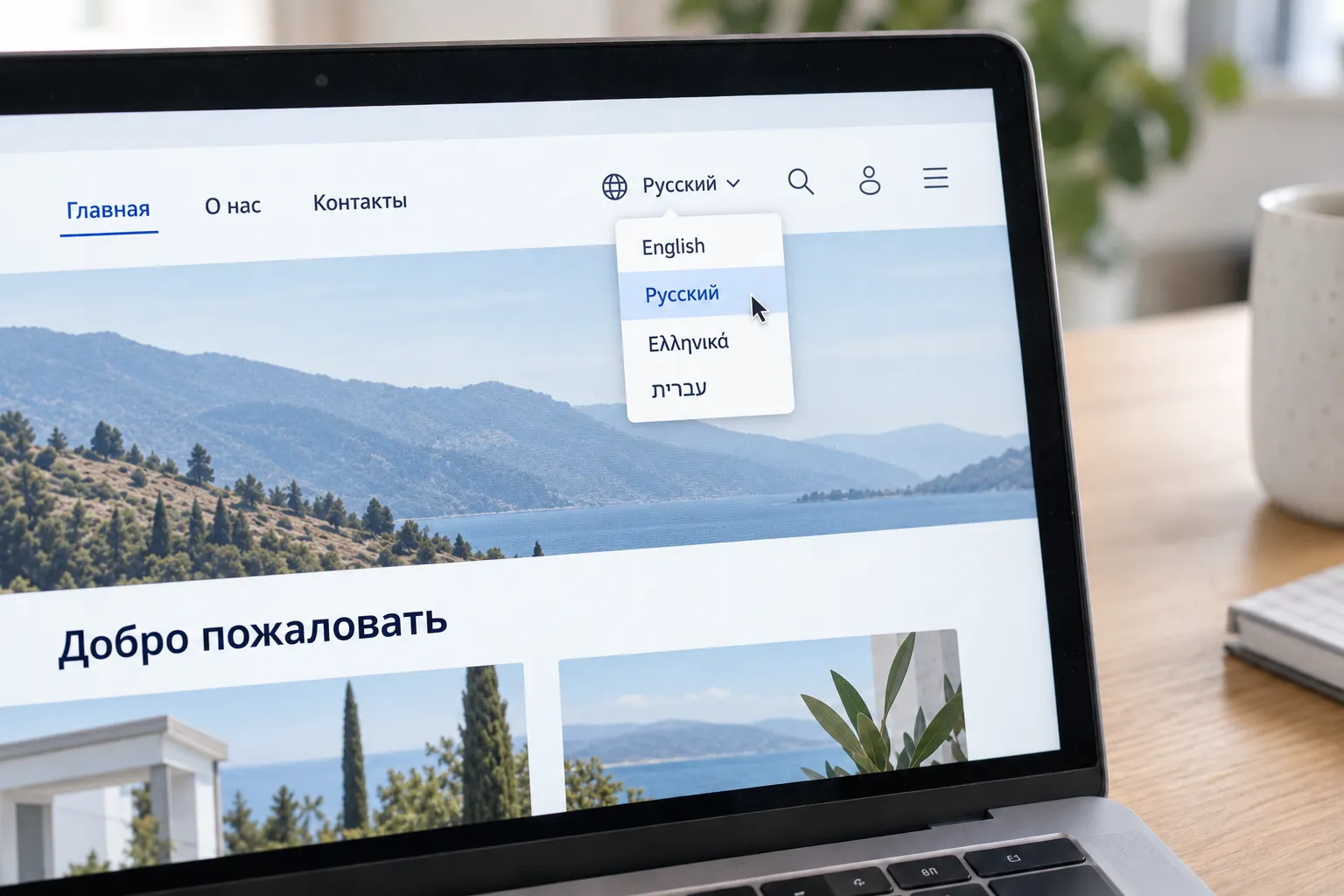
A customer finds you, opens your site on their phone, and the whole thing is in one language. They can probably read it. But reading and deciding are not the same thing, and the moment someone has to work a little harder than they expected, the back button is right there.
A second language is not a translation job. It is a second version of your website that happens to say the same things. That difference is what decides whether it brings you customers or quietly works against you.
Do you actually need a second language?
Not every business does, and a second language you cannot maintain is worse than one language done well. Before anyone quotes you for it, work out whether the demand is real.
The most honest test costs nothing: look at the language your enquiries already arrive in. Read the last fifty messages, the voicemails, the reviews, the questions people ask at the counter. If a steady share of them come in a language your website does not speak, you already have your answer. If they do not, put the budget into the language you have.
A few situations where a second version usually earns its place:
- Your customers live here but think in another language. Residents who have moved for work or family often search in their own language first, even after years.
- Visitors plan before they arrive. People book accommodation, tables, clinics and services from home, in their own language, weeks ahead.
- You sell to businesses abroad. A supplier or partner checking whether you are credible will read the site in whatever language they are comfortable judging you in.
- Your own team already switches. If your staff answer the phone in two languages every day, your website is the only part of the business that does not.
And one situation where it usually does not: a local business serving neighbours who all share one language. Adding English because it feels more professional is not a reason. It gives you two sets of pages to keep accurate and no new customers.
Can you just press translate?
This is the question everyone actually wants answered, so here is the straight version. You can. Google does not ban machine translation, and a plugin will produce something readable in minutes.
What Google does say is worth reading carefully. Its spam policies cover content generated at scale through automated transformations, translation included, where little value is added for the reader. In a 2024 Search Central office hours session, Google said that if an automatic translation is of low quality it may affect ranking, and advised having someone native in that language review and, where needed, fix it. So the line is not machine translation itself. The line is whether a person took responsibility for the result.
You can read both for yourself: Google’s spam policies for web search and its guidance on multi-regional and multilingual sites.
The practical problem is smaller and more annoying than a penalty. A plugin gets the grammar broadly right and the business wrong. It translates the name of your service into something nobody searches for. It converts a price into a currency you do not take. It turns a confident headline into a sentence that is technically correct and slightly strange, which is exactly how a visitor decides you are not quite serious. A machine is a fast translator and a poor copywriter, and your website is copywriting.
It is the digital version of a broken telephone: the message arrives, just not the one you sent.
Use the plugin if it helps you get a first draft on the page. Just do not let that draft be what a customer reads.
Will a second language split your Google ranking?
This is the fear that stops most people, and it is based on a misunderstanding worth clearing up.
Google is explicit that localised versions of a page are not duplicate content. They are only treated as duplicates if the main content is left untranslated, which is what happens when a site switches the menu and the buttons but leaves the actual text in the original language. Translate the content properly and each version can rank on its own, for searches in its own language.
In practice a second language usually widens what you can be found for rather than dividing it. The two versions are not competing for the same searches, because people searching in different languages are typing different words.
Subfolder, subdomain or separate domain?
Google asks for one thing here: give each language version its own address. Beyond that, all three structures work, and the choice is more about how you want to run the site than about search.
- Subfolder, like
/el/or/he/. Everything stays on one domain, one hosting setup, one set of analytics. Easiest to run, and the usual choice for a small business. This is what we use on this site. - Subdomain, like
el.yourbusiness.com. Useful if the versions are genuinely managed by different people or systems. - Separate domain per country. A real commitment: another domain to register, renew, secure and build authority for. Usually chosen for business reasons such as a separate legal entity, not for SEO.
Whichever you pick, every page needs its own address in every language. A single page that swaps its text when you click a flag has one address, so there is nothing for a search engine to show, link to or rank.
How does Google know which version to show?
Through hreflang: a small annotation on each page that says which version belongs to which language. Get it right and the correct version appears for the right person. Get it wrong and search engines can ignore the whole arrangement.
Google’s rules for it are short:
- Each version must list itself as well as every other version. If the English page points at the Greek one but the Greek page does not point back, the pair is not confirmed.
- The addresses must be full absolute URLs, not shortened paths.
- An
x-defaultentry is recommended, naming the version to fall back to when nothing matches the visitor.
The reciprocal part is where real sites break, and it is almost invisible from the outside. We will admit to it: this site carried exactly that fault for a while. The Hebrew pages named their English and Greek counterparts, but those pages did not name the Hebrew one back, so the whole cluster was unconfirmed. Everything looked fine to a visitor. It just meant the work of having a third language was not fully counted. We found it, fixed it in the sitemap and the page tags together, and added an automated check so it cannot quietly come back.
The full rules are in Google’s documentation on telling Google about localised versions of your pages.
Should the site switch language by itself?
It is tempting: detect where someone is, send them to the right version, save them a click. Google advises against it, and so do we.
The guidance is that automatic redirects based on language or location can prevent both users and search engines from seeing the other versions of a site. Google also points out that working out where someone is from their IP address is unreliable. Anyone on a work network, a VPN or a foreign SIM gets guessed wrong, and the person most likely to be guessed wrong is the international customer you added the language for.
What works better is unglamorous. Put a visible switcher where people expect it, at the top of the page. Let it take them to the same page in the other language, not back to the homepage, which is the single most common thing to get wrong. Remember the choice for next time. And never trap someone in a version they did not pick.
What “written again” actually means
Here is the part that plugins cannot do, and the reason we work the way we do.
Writing a second version means reading the original for its facts, closing it, and writing the page the way someone in that language would write it from scratch. Same prices, same promises, same limits. Different sentences, different order, sometimes a different example, because what persuades in one language falls flat in another.
Some concrete things that come up every time:
- Headlines do not survive translation. Wordplay, rhythm and anything clever is written again or dropped. A plain headline in the second language beats a clever one that sounds imported.
- Use the words people actually search. Every market has its own normal word for what you sell. The dictionary-correct term is sometimes not the one anybody types.
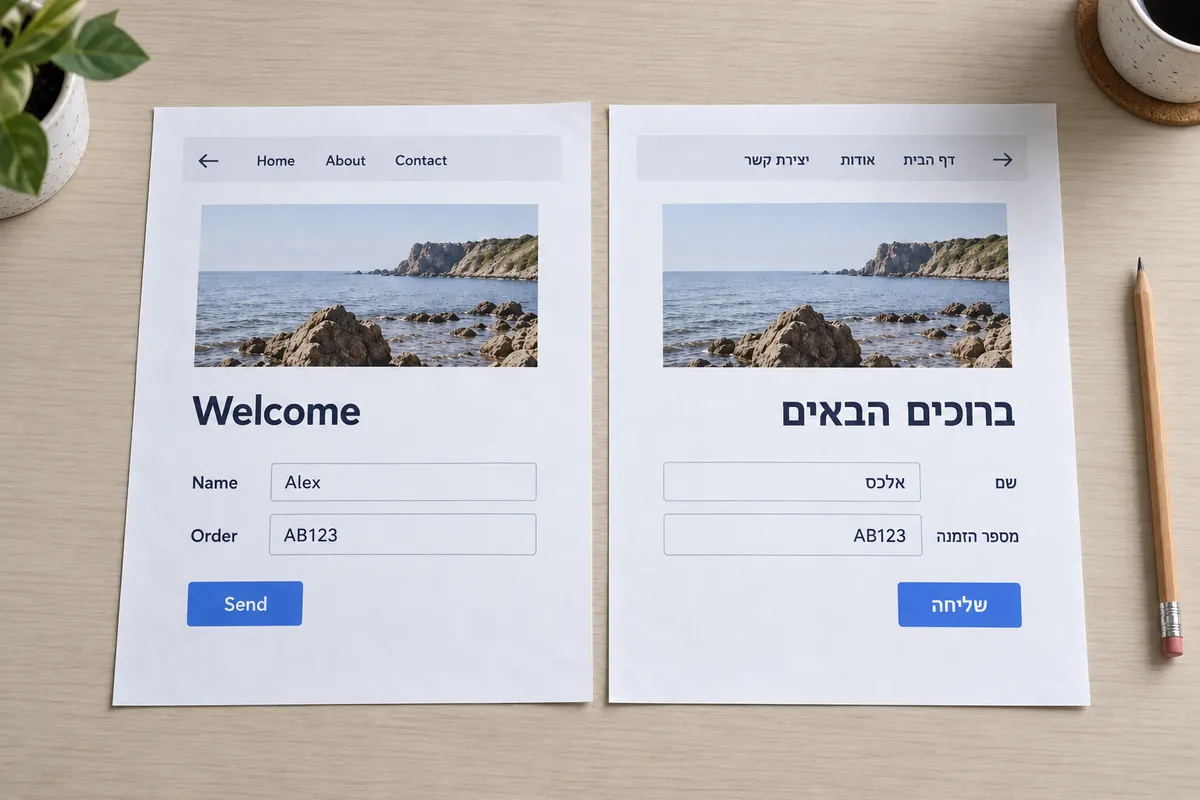
- Right-to-left is a rebuild, not a mirror. A Hebrew or Arabic version flips the layout, the navigation, the icons that imply direction and the form fields. Numbers, Latin brand names and phone numbers stay left to right inside a right-to-left line, which is where untested layouts fall apart.
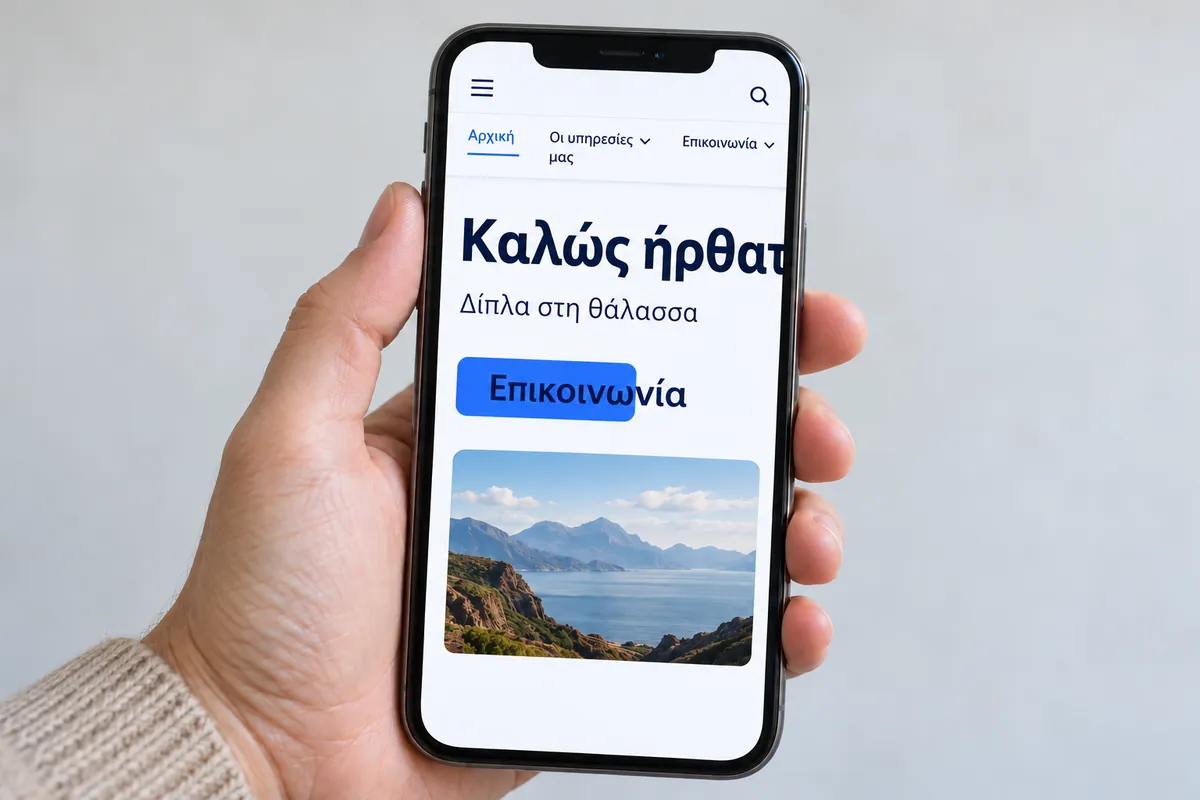
- Length changes everything. The same sentence can run a third longer in another language. Buttons, menus and headings that fit perfectly in one version overflow in the other, usually on a phone.
- The invisible text counts too. Form labels, error messages, the automatic email someone gets after they write to you, date and currency formats, the alt text on images. A site that switches language but sends its confirmation email in the original one has not really switched.
How do you know it is set up right?
You can check most of this yourself, on your own phone, in about ten minutes.
- Open any inside page and switch language. Do you land on the same page in the other language, or back on the homepage?
- Copy the address of a page in the second language. Does it have its own URL you could send to someone?
- Open the site from a different network or on mobile data. Are you redirected against your will?
- Send yourself a test enquiry from the second-language version. What language does the reply and the automatic email arrive in?
- Ask someone who actually speaks the language to read two pages out loud. Not to check the grammar, to tell you whether it sounds like a person.
- Check that every language version appears in your sitemap, and that the hreflang tags name each other both ways.
If the first and last of those are wrong, fix them before you spend anything on promoting the site. They are the two that waste the work you already paid for.
Common questions
Do I need my website in more than one language?
Only if your customers actually use more than one. A good test is the language your enquiries already arrive in: messages, calls, reviews and walk-ins. If people contact you in a language your website does not speak, a second version is worth costing. If they do not, spend the budget on the one language you have.
Can I just install an automatic translation plugin?
You can, and Google does not ban machine translation. Its spam policies cover content produced at scale through automated transformations, including translation, where little value is added for the reader. In a 2024 Search Central office hours session, Google said a low-quality automatic translation may affect ranking and advised having a native speaker review and fix the translations. Treat a plugin as a starting draft that a person still has to finish.
Will a second language create duplicate content and split my ranking?
No. Google states that localised versions of a page are not duplicate content, and are only treated as duplicates if the main content is left untranslated. Each language version can rank for searches in its own language.
Should the website detect the visitor's language and switch automatically?
Google advises against automatically redirecting people based on their language or location, because it can stop both visitors and search engines from reaching the other versions. It also notes that working out location from an IP address is unreliable. Offer a clear language switcher instead and let the visitor choose.
Is it better to use a subfolder, a subdomain or a separate domain?
Google asks for a separate URL for each language version, and any of the three can work. A subfolder such as /el/ is usually the simplest to run and keeps everything on one domain. A separate domain per country is a bigger commitment and is normally chosen for other business reasons.
What is hreflang and why does it matter?
It is the tag that tells search engines which version of a page belongs to which language. Each version has to list itself and all the other versions, using full absolute URLs, and an x-default entry is recommended as the fallback. If the versions do not confirm each other, the annotations can be ignored.
How much does a second language add to a website project?
It depends on how many pages carry real content and who writes the second version. Multilingual websites sit in our Enterprise / Custom scope rather than the standard packages, so they are quoted per project. The cost is mostly the writing and the ongoing updates, not the technical setup.
How can DM Labs help?
We run this site in three languages, and the version you are reading was written in English rather than translated into it. The Greek and Hebrew editions of this same guide were each written from scratch for their own readers. That is the standard we hold our client work to, because it is the only version of multilingual that actually works.
Multilingual websites sit in our Enterprise / Custom scope rather than the standard packages, so they are quoted per project once we know how many pages carry real content and who is writing the second version. Some clients write it themselves and have us handle the structure and the technical side. Others ask us to do all of it.
If you are weighing up a second language, bring the question rather than the finished plan. The useful first conversation is about who your customers are and which language they contact you in, not about plugins. Let’s talk
Illustrative images created for this guide.